Table of Contents
- How Does the MKS-8636M Digital Conference System Utilize Dual-Wiring Topology (RJ45 & 8-Pin) for Fail-Safe Networking?
- What UI/UX Engineering Principles Drive the MKS-8636M Multifunctional Full-Color Touchscreen Interface?
- How is PTZ Camera Video Tracking Engineered into the MKS-8636M Digital Conference System Architecture?
- What DSP Logic Governs the Real-Time Voting Matrices Within the MKS-8636M Multifunctional Conference System?
- How Are Chairman and Delegate Unit Priority Protocols Engineered in the MKS-8636M Digital Conference System?
- How Does the MKS-8636M Digital Conference System Integrate with Third-Party AV Central Control Interfaces?
- What Acoustic DSP Algorithms Ensure High-Fidelity Speech in the MKS-8636M Multifunctional Conference System?
- How is Power Over Cable (PoC) and Signal Distribution Engineered Across the MKS-8636M Daisy-Chain Network?
- How is the MKS-8636M Digital Conference System Engineered for Scalability in Government Halls and Boardrooms?
- Full Technical Specifications
- Conclusion: The Backbone of Modern Corporate Governance
- Frequently Asked Questions (FAQ)
When outfitting a modern government hall, a corporate boardroom, or an international summit venue, AV integrators are no longer just installing microphones. They are deploying complex data networks. A premier discussion space requires voting capabilities, automated camera tracking, absolute acoustic clarity, and foolproof networking. If a single microphone unit fails, or if the voting data is delayed by a fraction of a second, the integrity of the entire meeting is compromised.
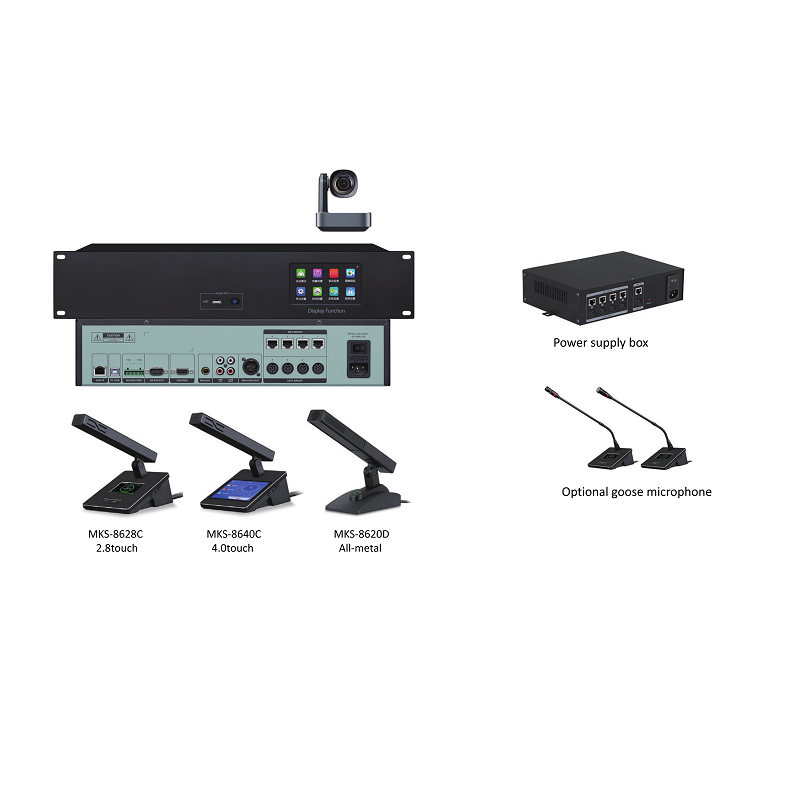
The MKS-8636M series represents the pinnacle of digital audio routing, integrated voting, and video tracking infrastructure.
To solve the rigorous demands of enterprise-level AV installations, we engineered the MKS-8636M Multifunctional Digital Wired Conference System (comprising the MKS-8628C, MKS-8640C, and MKS-8620D units). By combining an intuitive full-color touchscreen interface, robust dual-wiring topologies, and a deep central control matrix, this system transforms how organizations collaborate. Let’s dive straight into the hardware architecture and DSP algorithms that make this system the ultimate infrastructure choice for mission-critical discussion environments.
How Does the MKS-8636M Digital Conference System Utilize Dual-Wiring Topology (RJ45 & 8-Pin) for Fail-Safe Networking?
The physical layer of any conference system dictates its reliability and the speed at which AV contractors can deploy it. Traditionally, conference systems relied exclusively on proprietary multi-pin cables, which are difficult to terminate on-site and expensive to run through conduits. Conversely, relying solely on network cables can be a concern for legacy system upgrades.
We engineered the MKS-8636M with a highly versatile Dual-Wiring Topology. Every delegate and chairman unit is equipped with both traditional 8-pin DIN connectors and standard RJ45 ports. This allows contractors to utilize Cat5e/Cat6 ethernet cables for daisy-chaining the units. Cat6 cables are heavily shielded against electromagnetic interference (EMI), cost-effective, and can be terminated on the fly during installation. By structuring the network in a closed-loop or robust daisy-chain format, the digital audio and control data can flow seamlessly. If one cable segment is accidentally severed, the intelligent routing host can immediately identify the break and redirect data traffic, ensuring the rest of the boardroom remains fully operational.
What UI/UX Engineering Principles Drive the MKS-8636M Multifunctional Full-Color Touchscreen Interface?
When a high-level executive or government official sits at a boardroom table, they shouldn’t need an instruction manual to cast a vote or request to speak. The user interface (UI) must be completely frictionless.
The MKS-8636M units feature vivid 2.8″ or 4.0″ TFT Touch Options. Our software engineers designed the graphical user interface (GUI) based on strict cognitive load reduction principles. Utilizing capacitive touch technology, the screen offers smartphone-like responsiveness. During a standard discussion, the screen displays a high-contrast speaker timer and volume controls. The moment a voting session is initiated by the central host, the local GUI dynamically shifts to a secure voting matrix (Yes/No/Abstain) with large, color-coded hitboxes. This dynamic UI adaptation ensures that the hardware always presents exactly the tools the user needs at any given millisecond, eliminating confusion and speeding up parliamentary procedures.
How is PTZ Camera Video Tracking Engineered into the MKS-8636M Digital Conference System Architecture?
In hybrid meeting environments, static wide-angle cameras are no longer acceptable. Remote participants need to see the active speaker’s facial expressions clearly. The MKS-8636M natively solves this through integrated PTZ (Pan-Tilt-Zoom) Camera Video Tracking.
This isn’t an external add-on; it is hardcoded into the central host’s logic board. The system utilizes RS-485 and RS-232 serial communication ports to speak directly to the PTZ cameras via industry-standard VISCA or PELCO-D/P protocols. During commissioning, the AV integrator maps a specific 3D coordinate (a camera preset) to the unique ID of each microphone unit. The instant a delegate presses their microphone button, the central host fires a hexadecimal string to the camera. With near-zero latency, the camera snaps to the speaker, automatically framing them for the live stream or video conferencing codec. If multiple people speak, the logic processor elegantly switches to a wide shot, ensuring the video feed is always contextually accurate.
What DSP Logic Governs the Real-Time Voting Matrices Within the MKS-8636M Multifunctional Conference System?
Legislative assemblies and corporate boardrooms require voting systems that are absolutely tamper-proof and instantly responsive. The MKS-8636M handles this via a dedicated sub-processor within the main host that runs a high-speed polling algorithm.
When a vote is called, the host sends an encrypted broadcast packet down the RJ45/8-Pin daisy chain, activating the voting UI on all authorized delegate screens. As delegates press their screens, the units send encrypted data packets back to the host. The DSP logic is capable of processing hundreds of concurrent incoming data streams without collision. It instantly tallies the results, calculates percentages, and outputs this data via the central control interface to be displayed on the venue’s main LED video walls or projected screens in real-time. This localized processing ensures that the voting data is never subjected to external network latency or internet outages.
How Are Chairman and Delegate Unit Priority Protocols Engineered in the MKS-8636M Digital Conference System?
Order must be maintained in large-scale discussions. The MKS-8636M (specifically utilizing the MKS-8628C or MKS-8640C Chairman units) implements strict hardware-level priority protocols.
The central host processor acts as a gatekeeper, running logic modes such as FIFO (First In, First Out), LIMIT (restricting the maximum number of active mics), and CHAIRMAN ONLY. The Chairman unit is hardwired with an absolute priority interrupt. Regardless of how many delegate units (MKS-8620D) are currently active, pressing the Priority button on the Chairman unit sends an immediate override command to the host’s DSP. The host instantly mutes all active delegate audio channels and grants exclusive audio bus access to the Chairman. This interrupt logic is processed in less than 5 milliseconds, providing absolute control to the meeting facilitator.
How Does the MKS-8636M Digital Conference System Integrate with Third-Party AV Central Control Interfaces?
A premium digital conference system rarely operates in isolation. It needs to talk to the room’s Crestron, Extron, or AMX central control brain. We engineered the MKS-8636M host to be exceptionally friendly to third-party programmers.
Equipped with a dedicated RS-232 Central Control Interface, the host allows bi-directional communication. AV programmers can use simple ASCII or Hex strings to trigger systemic functions remotely. For example, a single button press on a Crestron iPad interface can dim the room lights, drop the projector screen, and simultaneously trigger the MKS-8636M host to open all microphones and initiate a roll-call sequence. This deep API-level integration makes the MKS-8636M the preferred choice for integrators building fully automated smart-boardrooms.
What Acoustic DSP Algorithms Ensure High-Fidelity Speech in the MKS-8636M Multifunctional Conference System?
Beyond the data networking, the fundamental purpose of this system is pristine audio capture. The MKS-8636M boasts a host Frequency Response of 20Hz – 20kHz, a Signal to Noise Ratio of > 96dBA, and Total Harmonic Distortion (THD) of < 0.05%. This isn’t achieved by accident; it requires aggressive acoustic DSP.
The audio signal path utilizes high-resolution Analog-to-Digital Converters (ADCs). Once digitized, the signal runs through a gauntlet of DSP algorithms. Automatic Gain Control (AGC) acts as an invisible sound engineer, instantly boosting the volume of a soft-spoken delegate while compressing a loud speaker, ensuring a uniform output level. Simultaneously, proprietary Acoustic Feedback Suppression (AFS) algorithms employ ultra-narrow notch filters to detect and eliminate resonant frequencies before they can evolve into a howling feedback loop, allowing the room’s PA volume to be pushed significantly higher.
How is Power Over Cable (PoC) and Signal Distribution Engineered Across the MKS-8636M Daisy-Chain Network?
Powering 50 or 100 individual microphone units with individual wall adapters would be an installation nightmare. The MKS-8636M solves this via Power over Cable (PoC).
The central host acts as a massive power supply, sending low-voltage DC power alongside the multiplexed digital audio and control data down the RJ45 or 8-pin cables. The engineering challenge here is voltage drop over long cable runs. To combat this, the circuitry inside each MKS-8636M microphone unit utilizes highly efficient DC-to-DC step-down converters. These components ensure that even the microphone at the very end of a 100-meter cable run receives the precise, clean voltage required to power its capacitive capsule and TFT touchscreen without flickering or audio degradation.
How is the MKS-8636M Digital Conference System Engineered for Scalability in Government Halls and Boardrooms?
An organization might start with a 20-person boardroom, but later expand to a 200-person summit hall. The architecture of the MKS-8636M is intrinsically scalable.
The main host features multiple output loops. When the capacity of the internal power supply is reached, integrators simply patch in specialized extension power supply units to the daisy chain. The central processor’s IP-routing capabilities dynamically assign unique addresses to newly connected microphones in real-time. This means expanding the system from 30 units to 250+ units requires no complex reprogramming; it is quite literally plug-and-play, providing ultimate future-proofing for the venue’s infrastructure.
Full Technical Specifications
| Host Specifications | Details |
|---|---|
| Frequency Response | 20Hz – 20kHz |
| Signal to Noise Ratio | > 96dBA |
| Total Harmonic Distortion | < 0.05% |
| Central Control Interface | RS-232 |
| Unit Specifications | Details |
| Sensitivity | -46dBV/Pa |
| Max SPL | 125dB (THD < 3%) |
| Display Screen | 2.8″ / 4.0″ TFT Touch Options |
Conclusion: The Backbone of Modern Corporate Governance
When you look at the MKS-8636M, you aren’t just looking at a microphone; you are looking at the central nervous system of a boardroom. By successfully integrating PTZ video tracking, high-speed encrypted voting matrices, and deep RS-232 central control capabilities over a robust dual-wiring topology, Maccus has engineered a platform that leaves nothing to chance. With pristine acoustic performance (20Hz–20kHz fidelity) and uncompromising scalability, the MKS-8636M is the definitive infrastructure choice for AV integrators tasked with building the boardrooms and government halls of tomorrow.
Frequently Asked Questions (FAQ)
Can I mix standard RJ45 Cat6 cables with traditional 8-pin cables in the same setup?
Yes, the dual-wiring topology of the MKS-8636M allows for incredible flexibility. You can utilize traditional 8-pin cables for specific segments and standard RJ45 Cat6 ethernet cables for others, making retrofits and new installations highly adaptable.
Does the PTZ video tracking require a separate software server?
No. The video tracking logic is built directly into the MKS-8636M central host. By utilizing RS-485 or RS-232 serial connections and standard VISCA/PELCO protocols, the host triggers camera presets natively, eliminating the need for expensive third-party video tracking servers.
How secure is the voting data transmitted across the system?
Extremely secure. The voting data is transmitted via proprietary encrypted broadcast packets over a closed-loop, hardwired local network. Because the system does not rely on external Wi-Fi or internet access to process votes, it is completely insulated from external cyber threats.
Is the MKS-8636M compatible with Crestron or Extron control systems?
Yes. The central host features a dedicated RS-232 central control interface. We provide a full list of API serial commands, allowing AV programmers to seamlessly integrate the conference system with Crestron, Extron, AMX, and other major central control brains for complete room automation.