Table of Contents
- The Foundation of Trust: An Introduction to Maccus Audio
- What Electro-Acoustic Validation Protocols Drive Maccus’s Zero-Defect Quality Control (QC)?
- Why Are High-Frequency Oscilloscopes and RF Signal Generators Crucial for UHF Calibration?
- How Do Audio Analyzers Ensure Flat Frequency Response and High-Fidelity Transducer Performance?
- What Role Does Precision Soldering Play in Minimizing Impedance and Preserving Signal Integrity?
- How is Total Harmonic Distortion (THD) and Signal-to-Noise (S/N) Ratio Quantified in the Acoustic Lab?
- How Does Automated Optical Inspection (AOI) Instrumentation Ensure Flawless PCB SMT Manufacturing?
- What Accelerated Life Testing Equipment Guarantees the Physical Durability of Wireless Audio Chassis?
- How Does Automated Laser Engraving Instrumentation Deliver Precision OEM Logo Customization?
- How Does Lab-Verified Instrumentation Ensure Global RF Compliance (FCC/CE) for B2B Partners?
- Conclusion: Securing Your AV Infrastructure with Lab-Verified Manufacturing
- Frequently Asked Questions (FAQ)
Let’s have a candid conversation about professional audio manufacturing. When you are an AV integrator outfitting a massive corporate boardroom, or a global distributor sourcing thousands of wireless microphone systems, the glossy marketing brochures don’t matter. What matters is what happens when you turn the equipment on in a room filled with 500 people. Does the RF signal hold? Is the audio fidelity pristine?
In the B2B audio sector, reliability is not created by chance; it is engineered through ruthless, uncompromising quality control. You cannot simply “assemble” a high-performance wireless microphone; you must validate its physics. Today, we are opening the doors to our testing facilities. We want to show you exactly how we utilize advanced instrumentation—from high-frequency oscilloscopes to anechoic audio analyzers—to guarantee that every unit leaving our production line performs flawlessly.
The Foundation of Trust: An Introduction to Maccus Audio
Before we dive into the technical instrumentation, you need to know who is running the tests. Enping Maiku Electronic Technology Co., Ltd. (operating globally under the brand Maccus) is a recognized National High-Tech Enterprise founded in 2009. We didn’t just appear overnight. Over the past 15 years, we have built a reputation in the heart of China’s electro-acoustic manufacturing base by prioritizing one thing: engineering truth. To understand the full scope of our history and our transition from a localized factory to a premier global OEM/ODM partner, you can explore our full story on our About Us page.
What Electro-Acoustic Validation Protocols Drive Maccus’s Zero-Defect Quality Control (QC)?
A “zero-defect” policy sounds great in a sales pitch, but it requires a staggering amount of capital investment in testing protocols to make it a reality. At Maccus, our QC protocol is not a random spot-check at the end of the assembly line. It is a multi-tiered matrix. We validate the raw materials upon entry, we validate the printed circuit boards (PCBs) during SMT placement, we validate the semi-finished chassis, and we perform 100% individual testing on fully assembled units in our electro-acoustic labs. This protocol ensures that any microscopic variance in impedance or capacitance is caught and rectified before the product is boxed.
Why Are High-Frequency Oscilloscopes and RF Signal Generators Crucial for UHF Calibration?
The UHF (Ultra-High Frequency) spectrum is highly volatile. If a wireless receiver’s Phase-Locked Loop (PLL) circuit is even slightly misaligned, the system will suffer from intermodulation distortion or complete signal dropouts.
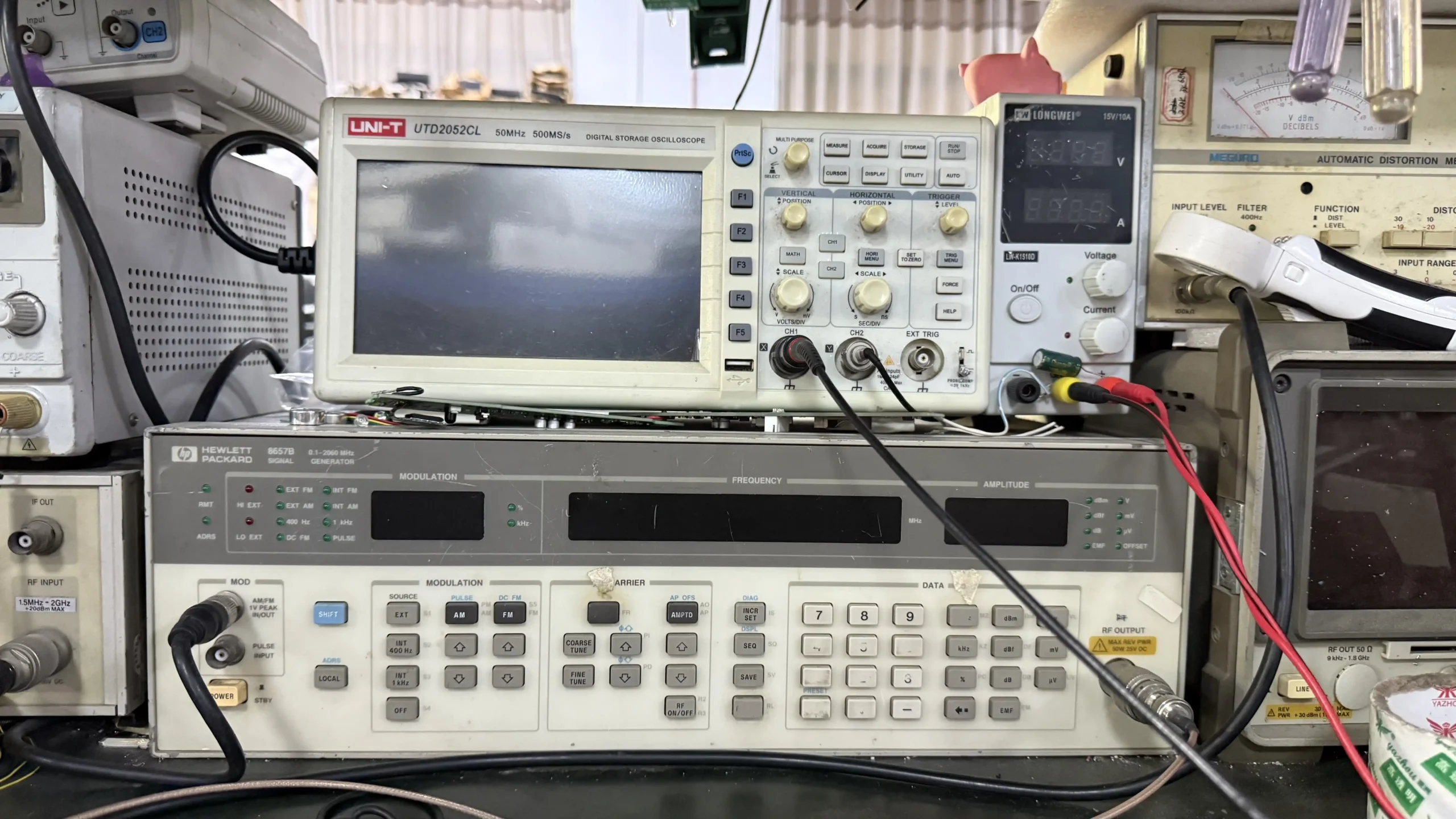
Precise RF signal generators and oscilloscopes are used to anchor the PLL frequency, ensuring unshakeable wireless stability.
This is why our engineers rely heavily on high-frequency oscilloscopes paired with RF signal generators. As shown in our lab, we inject known, highly complex RF waveforms directly into the receiver’s front-end circuitry. The oscilloscope allows us to visually measure the phase noise and verify the exact sensitivity of the receiver (often pushing past -96dBm). We calibrate the quartz crystal oscillators in real-time, ensuring that the radio frequency remains anchored perfectly to its center, regardless of thermal expansion during an intense 4-hour live performance.
How Do Audio Analyzers Ensure Flat Frequency Response and High-Fidelity Transducer Performance?
RF stability means nothing if the microphone sounds like a tin can. Creating a microphone that accurately reproduces the human voice requires bridging the gap between mechanical engineering and acoustic physics.
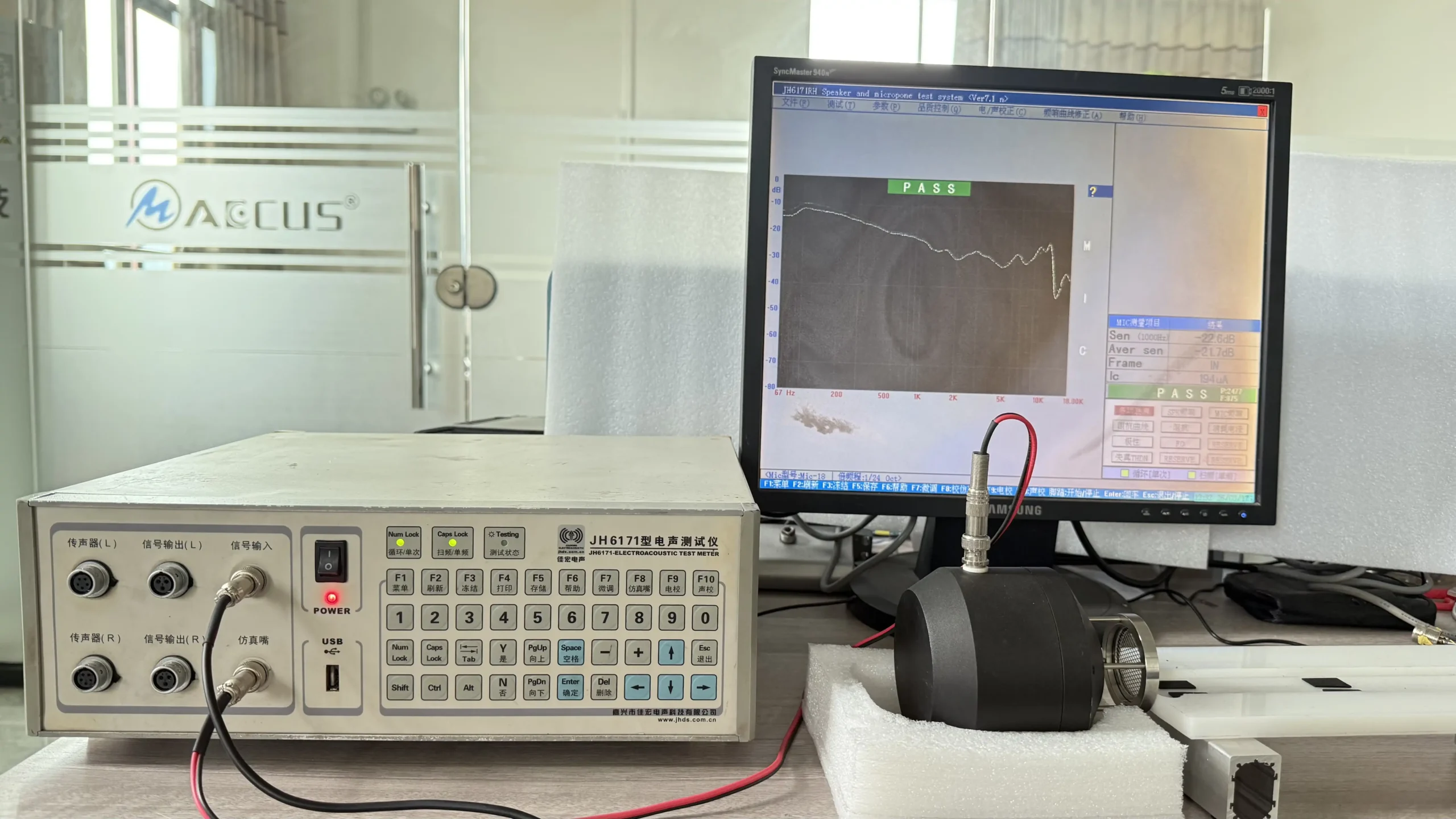
Electro-acoustic analyzers map the exact frequency response of our custom capsules, guaranteeing high-fidelity vocal reproduction.
We utilize dedicated audio analyzers within a sound-isolated environment to map the behavior of our transducer capsules. We send specialized frequency sweeps (from 20Hz up to 20kHz) through the microphone. The analyzer plots a real-time graph of the frequency response. If we are engineering a dynamic microphone for a rock vocalist, we tune the capsule for a slight presence boost around 4kHz to cut through the mix. If we are building a gooseneck mic for a corporate boardroom, we tune it for a hyper-flat, natural response. The instrumentation allows us to move past subjective “listening tests” and rely on hard, repeatable data.
What Role Does Precision Soldering Play in Minimizing Impedance and Preserving Signal Integrity?
While we heavily utilize automation for surface-mount components, the critical junction points in an analog audio path still require the artisanal touch of an expert engineer.
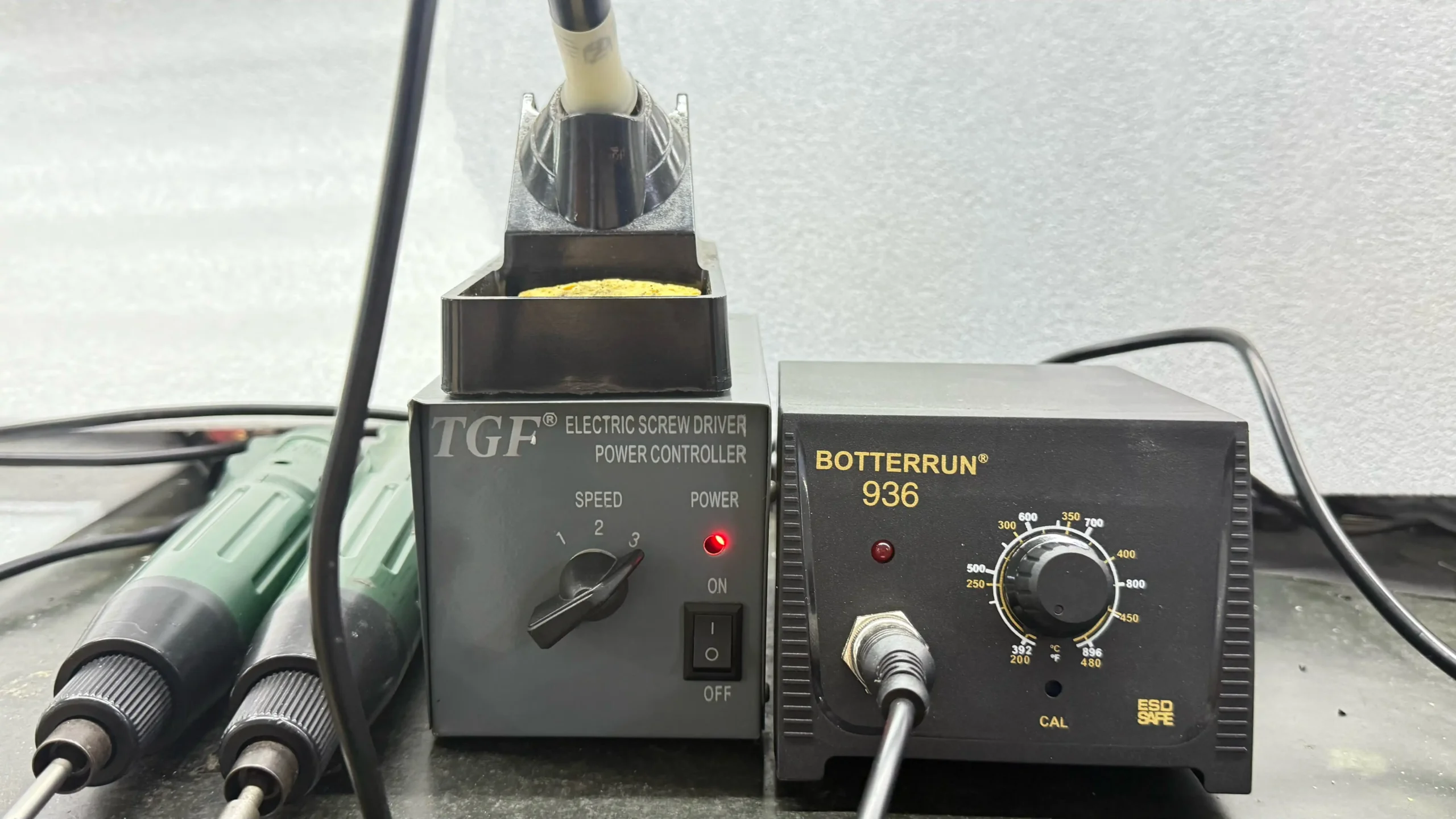
Precision hand-soldering at critical acoustic junctions prevents oxidation and maintains low circuit impedance.
Look at our precision soldering stations. The connection between a delicate condenser capsule and the main PCB transmitter board is incredibly sensitive. A “cold” solder joint or slight oxidation can alter the capacitance of the circuit, subtly degrading the high-frequency “air” of the microphone. Our technicians use temperature-controlled stations and silver-bearing solder to guarantee maximum conductivity. This meticulous attention to impedance matching ensures that the analog signal integrity is perfectly preserved before it is digitized or modulated.
How is Total Harmonic Distortion (THD) and Signal-to-Noise (S/N) Ratio Quantified in the Acoustic Lab?
Two of the most critical specs on any audio equipment datasheet are THD (Total Harmonic Distortion) and the Signal-to-Noise (S/N) ratio. When you purchase from Maccus, those numbers aren’t estimates; they are laboratory-certified facts. Using our audio analyzers, we inject a pure 1kHz sine wave into the system. The analyzer then listens to the output and calculates exactly how much extra harmonic noise the system’s circuitry added to the original signal. By isolating the PCB layout and utilizing premium compander chips, we consistently verify our THD at strict levels (often < 0.3%) and our S/N ratio at > 100dB, guaranteeing a whisper-quiet noise floor.
How Does Automated Optical Inspection (AOI) Instrumentation Ensure Flawless PCB SMT Manufacturing?
Modern digital conference systems and wireless receivers rely on incredibly dense Printed Circuit Boards (PCBs). A single misplaced resistor, off by a fraction of a millimeter, can cause a catastrophic failure. To prevent this, our SMT (Surface Mount Technology) lines are equipped with Automated Optical Inspection (AOI) instrumentation. High-speed cameras capture microscopic images of the PCB immediately after the reflow oven. The AOI software uses advanced algorithms to compare the freshly soldered board against the perfect CAD blueprint, instantly detecting solder bridges, missing components, or tombstoning errors before the board ever reaches the assembly phase.
What Accelerated Life Testing Equipment Guarantees the Physical Durability of Wireless Audio Chassis?
B2B audio gear is subjected to tremendous abuse. It is thrown into flight cases, dropped by stagehands, and operated in sweltering outdoor festivals. Therefore, acoustic testing isn’t enough; we must test for physical survival. Our facility employs accelerated life testing equipment, including vibration tables that simulate the harsh realities of cross-country shipping, and climate chambers that push the hardware through extreme temperature and humidity cycles. This ensures that the aerospace-grade aluminum chassis and the internal shock-mounts of our microphones will not crack or fail under real-world touring conditions.
How Does Automated Laser Engraving Instrumentation Deliver Precision OEM Logo Customization?
As a premier OEM/ODM partner, we understand that our manufacturing excellence must seamlessly translate into your brand equity. A poorly printed logo instantly cheapens a premium product.
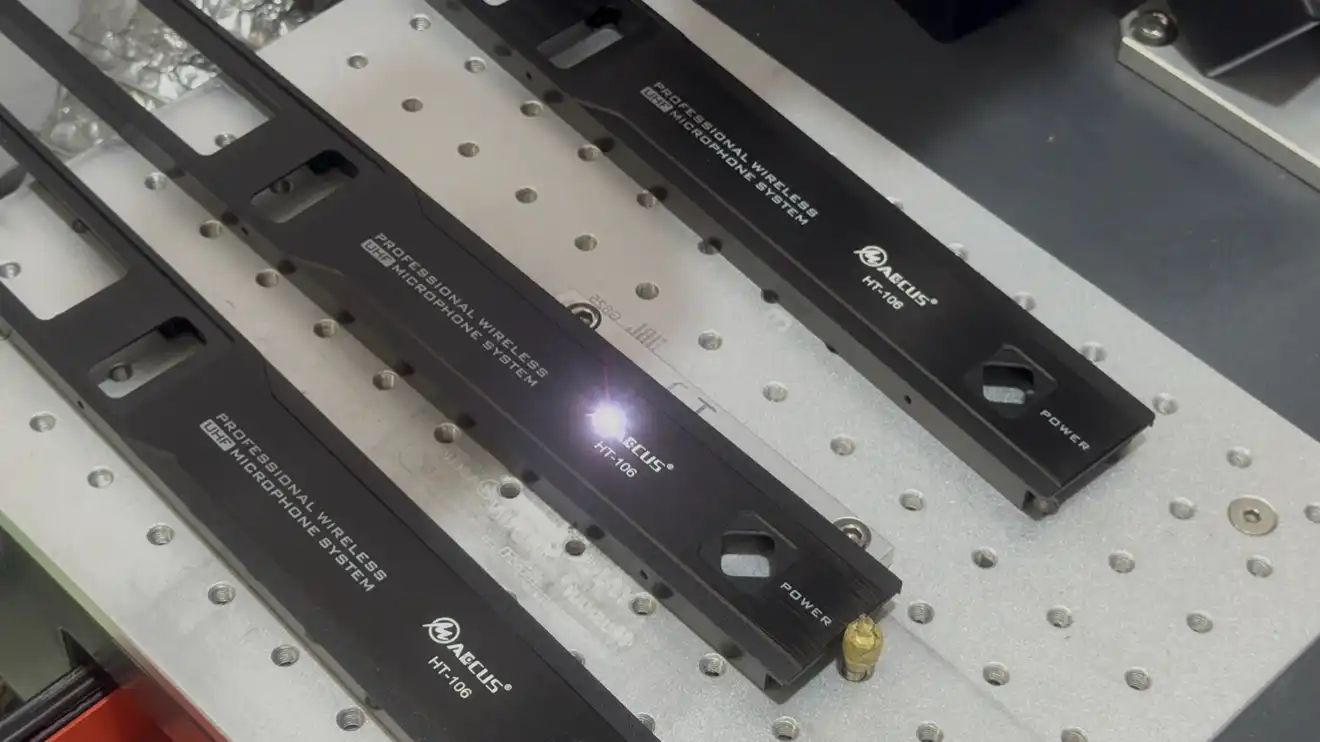
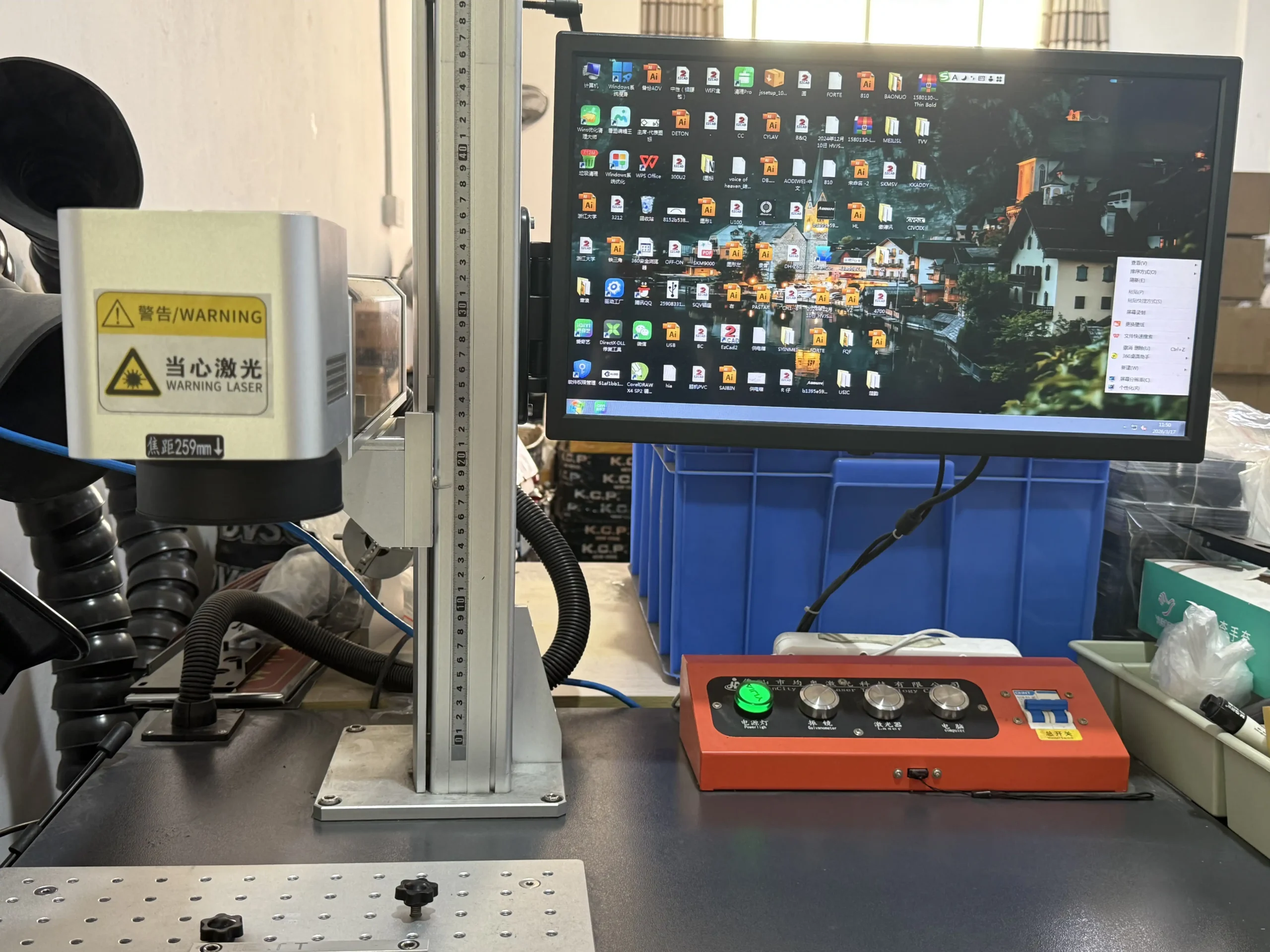
To solve this, we utilize industrial-grade CNC automated laser engraving machines. Unlike cheap silk-screening that chips and fades over time, our laser instrumentation vaporizes the top layer of the anodized aluminum chassis, permanently etching your brand’s logo into the metal with micrometer precision. Whether it is a complex corporate crest or a minimalist modern font, the laser ensures perfectly sharp, indelible branding that communicates luxury and authority to your end-users.
How Does Lab-Verified Instrumentation Ensure Global RF Compliance (FCC/CE) for B2B Partners?
For global distributors, regulatory compliance is the ultimate gatekeeper. Shipping non-compliant RF equipment into the US or European markets can result in massive fines and confiscated inventory. Because we utilize laboratory-grade spectrum analyzers, we can guarantee that our wireless systems adhere strictly to local telecommunications laws. We can actively measure the exact transmission power (mW output) and verify that our systems produce zero illegal harmonic spurious emissions outside of the designated operating bandwidth. This hard data allows our systems to easily pass the stringent requirements of the Federal Communications Commission (FCC) and European CE (RED Directive) certifications, completely de-risking the import process for our B2B partners.
Conclusion: Securing Your AV Infrastructure with Lab-Verified Manufacturing
In the professional AV industry, hope is not a strategy. You cannot hope a wireless microphone will work; you must know it will. By combining 15 years of electro-acoustic expertise with a staggering arsenal of QC instrumentation—from RF signal generators and audio analyzers to automated optical inspection and laser branding—Maccus removes the guesswork from global sourcing. We are not just manufacturing audio equipment; we are engineering peace of mind. We invite you to explore our fully verified inventory of Professional Audio Products and discover what true, lab-verified manufacturing can do for your brand.
Frequently Asked Questions (FAQ)
Can Maccus provide QC documentation and frequency test reports for large OEM orders?
Absolutely. Because our manufacturing process is data-driven, we can provide comprehensive QC documentation, including oscilloscope phase noise charts and acoustic frequency response graphs, ensuring total transparency for your engineering and procurement teams.
How does your testing ensure multiple wireless systems won’t interfere with each other?
We utilize RF spectrum analyzers to map intermodulation distortion (IMD). Before finalizing the firmware for our multi-channel receivers, we mathematically verify and test the channel groupings to ensure that even if 20 microphones are turned on simultaneously, their RF carriers will not overlap or create harmonic interference.
Is the laser engraving service available for low-volume ODM orders?
Yes. Unlike traditional mold-stamping or silk-screening, our CNC laser engraving machines require very little setup time. This flexibility allows us to offer premium, permanent logo customization for our B2B partners even on relatively low-volume ODM or OEM production runs.
How does the factory handle changes in international RF regulations?
Our R&D team actively monitors changes in FCC, CE, and global telecom regulations. Because we design our own PCB layouts and program the PLL synthesizers in-house using lab-verified instruments, we can swiftly adjust the tunable bandwidths and transmission power of our systems to maintain immediate legal compliance for any target market.