In This Article
- 1. Navigating EU Compliance Without the Headache
- 2. Tuning the Capsule: Why One Size Doesn’t Fit All
- 3. The Backbone: Smart PCB Layouts & SMT Lines
- 4. Where Automation Meets the Human Touch
- 5. Surviving Europe’s Crowded UHF Spectrum
- 6. Real-World Rack Integration & EMI Shielding
- 7. Firmware That Actually Feels Like Your Brand
- 8. Trust, but Verify: Our Acoustic Lab Protocols
- 9. Speed to Market via the Enping Ecosystem
- Frequently Asked Questions
Let’s be real for a second. If you’re sourcing professional audio gear for the European market, buying off-the-shelf, white-labeled products is a risky game. European AV integrators and touring companies don’t just want something that works; they demand strict regulatory compliance, bulletproof RF stability, and hardware that actually integrates with their existing setups. To pull that off, you need more than a basic supplier. You need an R&D arm.
That’s where we come in. Here at Enping Maiku Electronic Technology Co., Ltd. (Maccus), we’ve spent the last 15 years quietly acting as the manufacturing engine behind several highly reliable wireless audio brands. We aren’t just slapping logos on generic chassis. We’re an established National High-Tech Enterprise specializing in deep ODM (Original Design Manufacturer) partnerships.
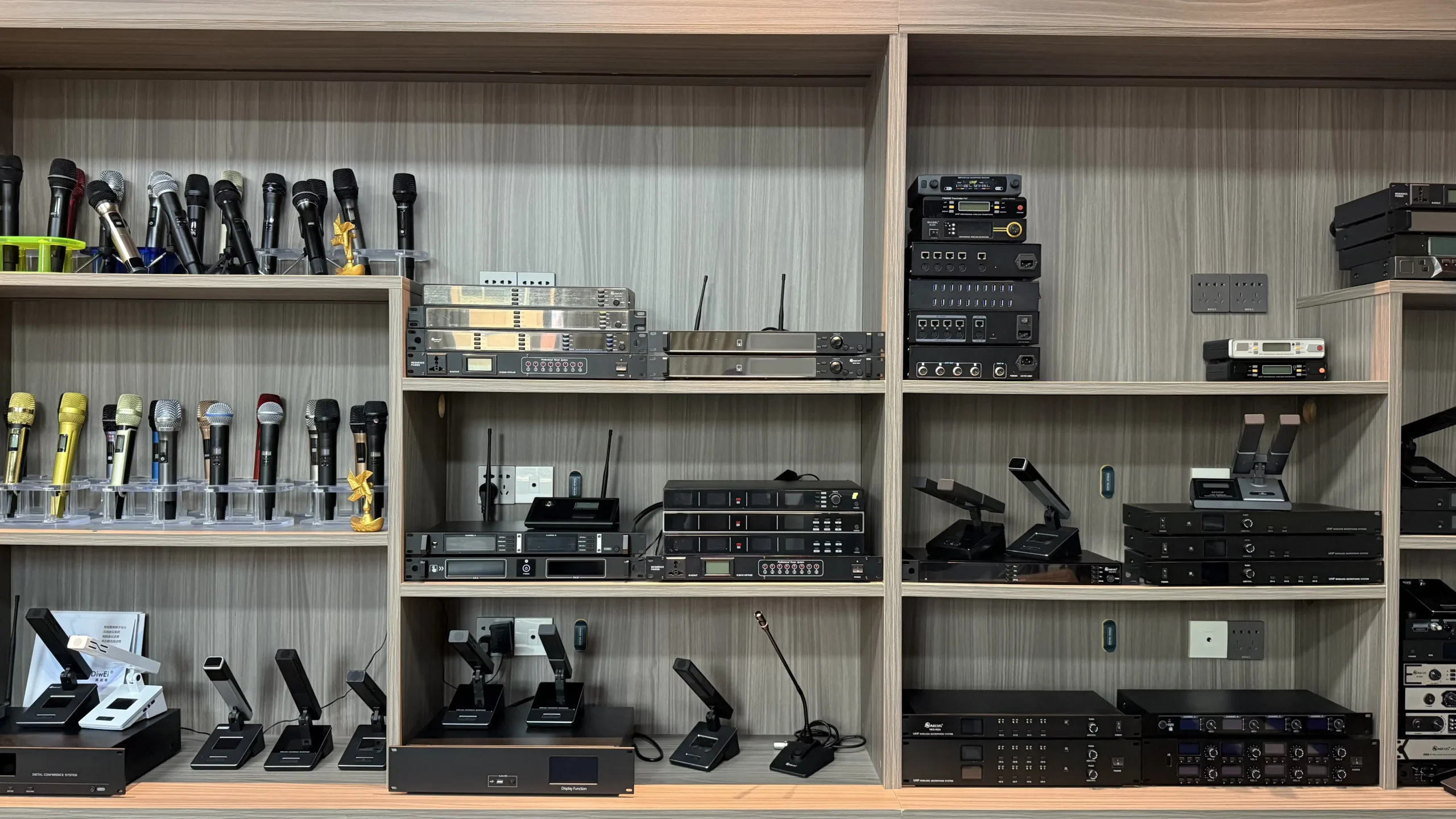
Our showroom isn’t just a catalog; it’s a starting point for your brand’s proprietary ecosystem.
Take a look at the showroom above. To most people, that looks like a room full of finished goods. But when we walk an ODM partner through those doors, we see a room full of modular blueprints. You pick the physical architecture, and then we sit down to re-engineer the acoustics, the RF bands, and the DSP until it’s a proprietary product that belongs entirely to your brand. Here is exactly how we make that happen.
1. Navigating EU Compliance Without the Headache
Breaking into the European market means dealing with some of the strictest telecom regulations on the planet. The Radio Equipment Directive (RED) and CE markings aren’t just suggestions. If your gear steps on a local emergency broadcast frequency, the fines are brutal, and the hit to your brand’s reputation is worse.
We tackle this before a single circuit is printed. Our engineering team maps out your specific target regions in Europe to custom-tune the antenna arrays. We cap the transmission power exactly where it needs to be (whether that’s 10mW or 50mW depending on local laws) and lock the bandwidth to legal white spaces. By baking this compliance directly into the hardware, we save you from massive headaches at customs.
2. Tuning the Capsule: Why One Size Doesn’t Fit All
A microphone meant for a highly reverberant cathedral in Rome needs a completely different acoustic profile than one installed in a carpeted boardroom in Berlin. When we develop your product, we start with the use-case. If your clients are doing live sound, we’ll build dynamic capsules with lightweight neodymium magnets, pushing a presence peak around 4kHz so the vocals cut through a heavy mix. If you’re selling to the premium corporate sector, we shift to wide-diaphragm condensers tuned for a hyper-flat, natural response. We adjust the acoustic baffling to tighten the pickup pattern, which dramatically cuts down on feedback.
3. The Backbone: Smart PCB Layouts & SMT Lines
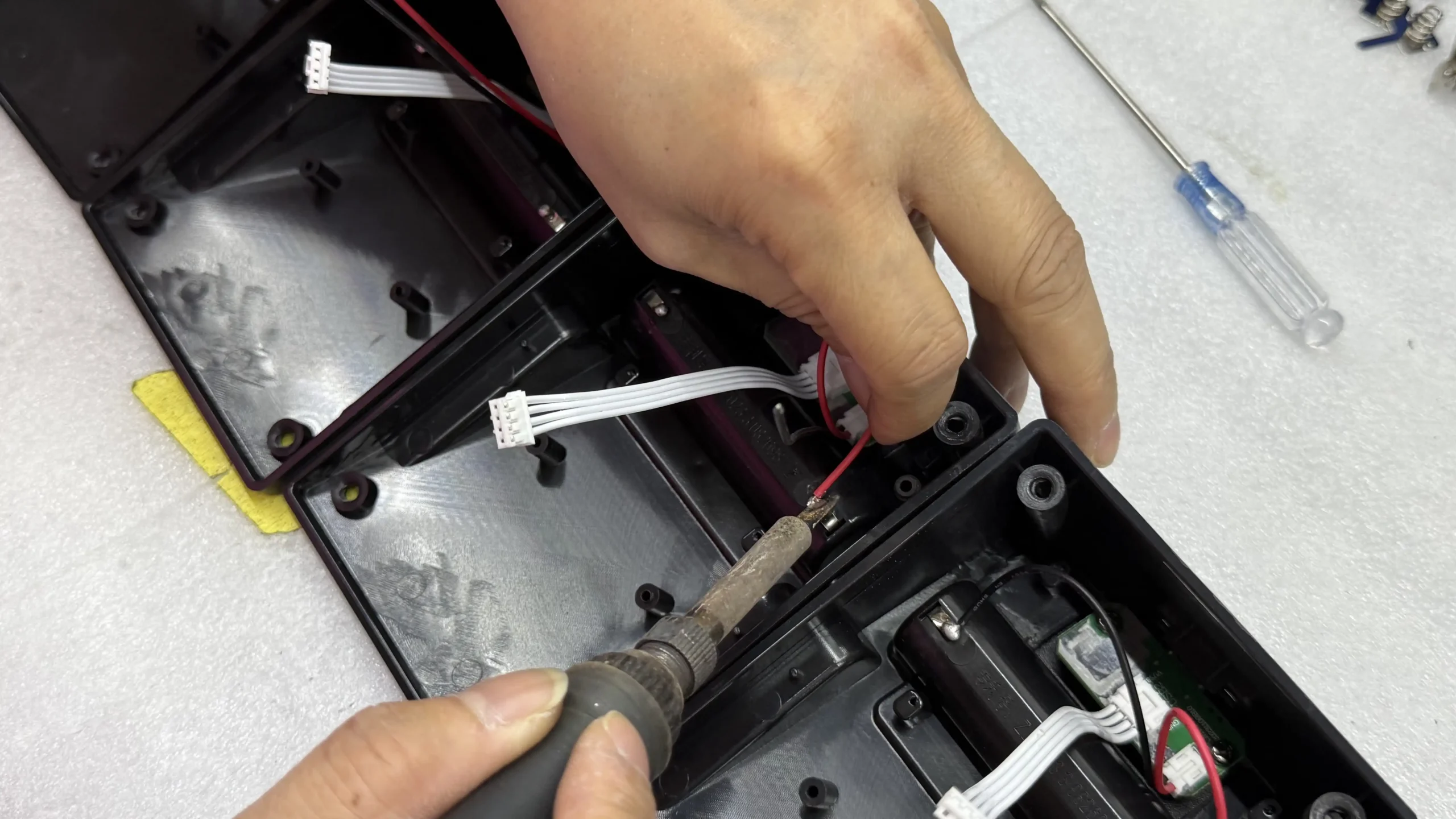
If you want to know why a cheap wireless mic sounds like digital garbage, look at the circuit board. Poor PCB routing causes internal crosstalk—basically, the noisy digital processing components bleed into the sensitive analog audio path.
Our SMT (Surface Mount Technology) lines are built to prevent exactly that. When we draft a custom PCB for your brand, we physically isolate the RF receiving circuits from the DSP drivers. Our automated robotics place microscopic PLL chips with sub-millimeter precision. This level of automation means the 5,000th unit we ship you performs exactly like the first prototype you approved.
4. Where Automation Meets the Human Touch
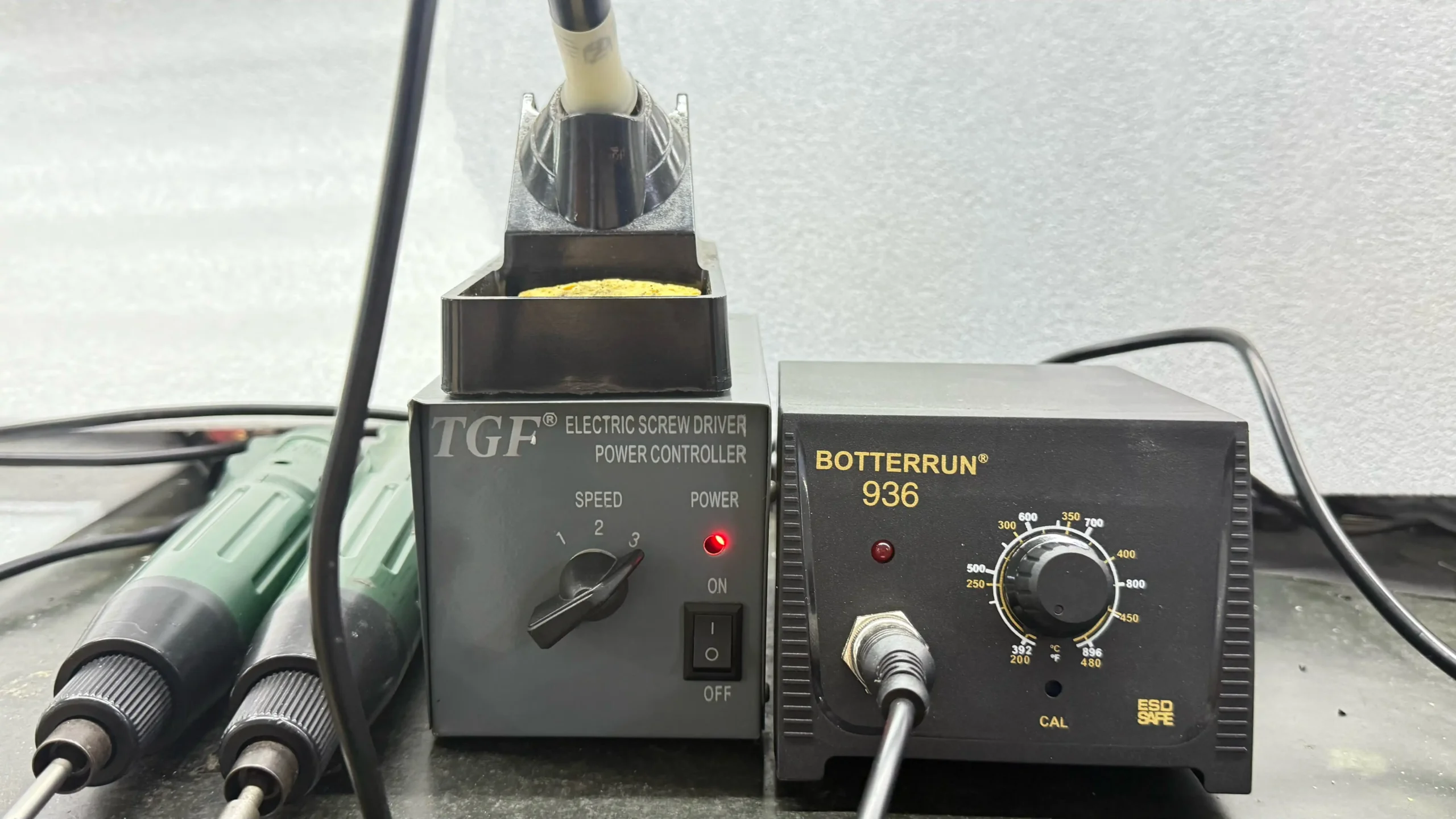
Automation is great, but the soul of pro audio still requires an expert’s hand. The connection points between the transducer capsule and the main board are highly vulnerable. A sloppy, cold solder joint can subtly change the circuit’s impedance, rolling off the high-end frequencies. That’s why our senior technicians handle the final assembly of the critical audio pathways. We use oxygen-free copper wiring and silver-bearing solder. It takes a little longer, but it’s the only way to guarantee the gear survives the abuses of European touring.
5. Surviving Europe’s Crowded UHF Spectrum
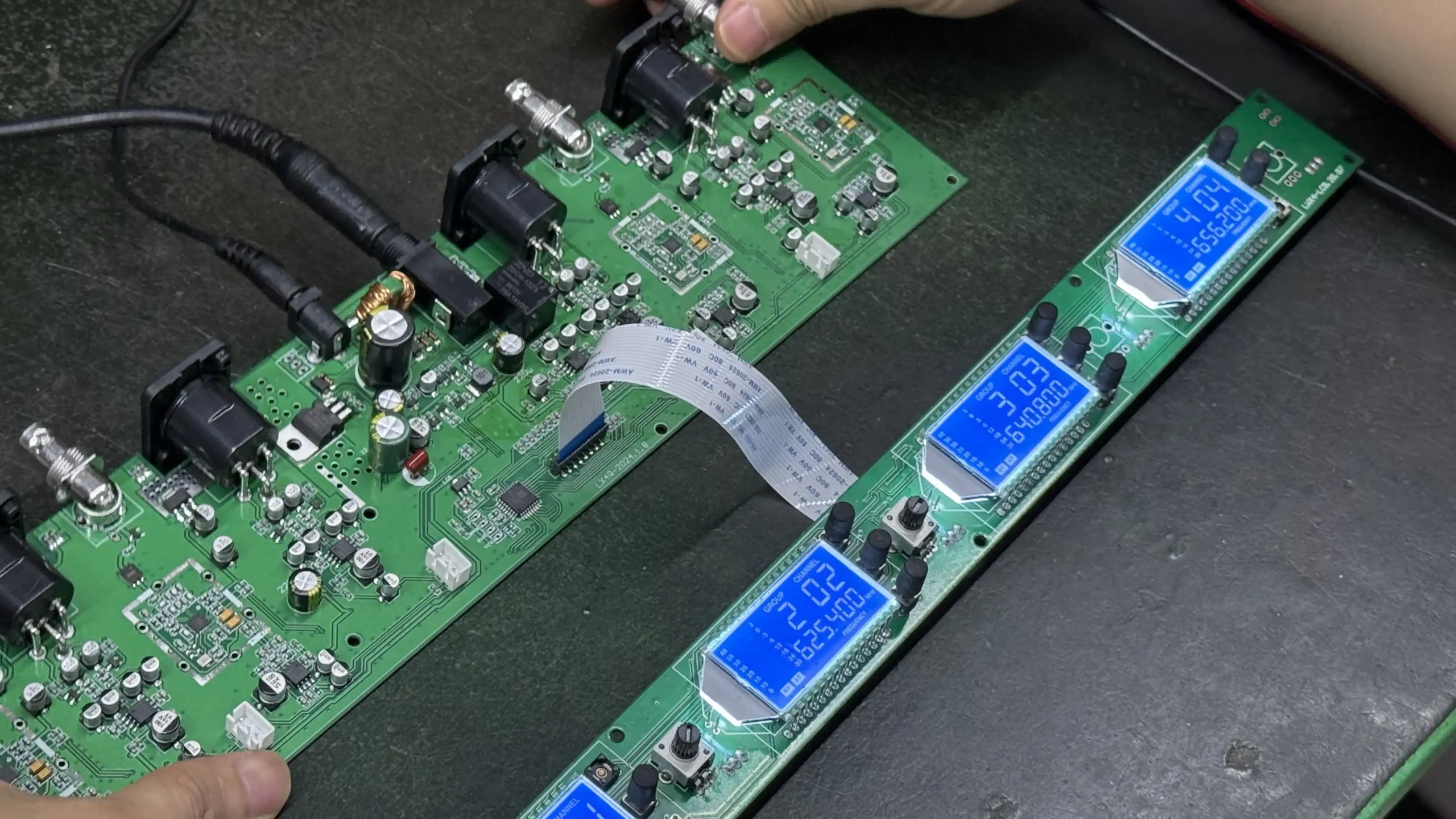
Europe’s UHF spectrum is a mess right now. Between 5G rollouts and digital TV, finding clean air space is tough. Your gear has to be incredibly stable. As you can see in the lab shot above, every custom UHF receiver we build is hooked up to high-frequency oscilloscopes for calibration. We use Phase-Locked Loop (PLL) architecture to anchor the radio waves. Even if a handheld mic heats up during a sweaty three-hour gig, the PLL circuit detects any phase drift and snaps the frequency right back to center.
6. Real-World Rack Integration & EMI Shielding
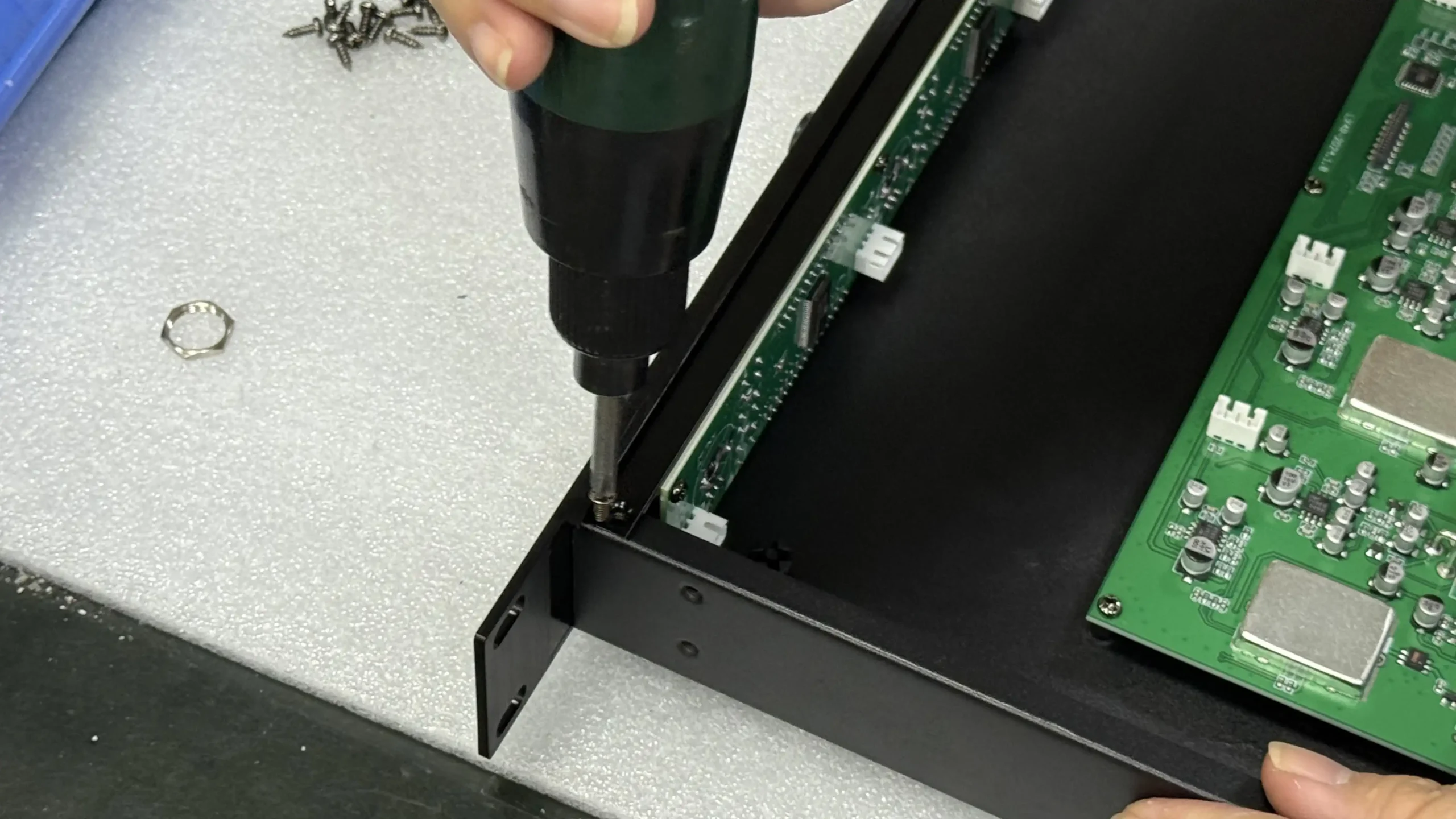
AV integrators rarely get to place receivers on nice, clean desks. They cram them into 1U racks directly above massive, heat-generating amplifiers. That’s a nightmare for electromagnetic interference (EMI). We engineer our metal chassis to act as a Faraday cage. We use thickened aerospace-grade aluminum and integrate specific inductors into the power supply rails to filter out dirty AC power. The result? Analog audio that leaves the receiver completely free of 60Hz hums.
7. Firmware That Actually Feels Like Your Brand
Hardware is only half the battle. If the user interface feels clunky, the whole system feels cheap. We offer deep firmware customization so your products feel premium the second they power on. We’ll code your logo into the OLED startup sequence. Need a proprietary digital pilot tone so your receivers only sync with your specific mics? We can do that. Want custom EQ presets hardcoded into the menu? Just give us the specs, and our software team will handle it.
8. Trust, but Verify: Our Acoustic Lab Protocols
In this industry, data beats promises every time. Before any bespoke wireless system leaves our factory, it has to survive our sound-isolated acoustic labs. We run standardized 1kHz audio sweeps through the hardware and measure it with precision analyzers. We ensure Total Harmonic Distortion (THD) stays strictly below 0.4%, and we verify the Signal-to-Noise Ratio hits the mark. It’s a rigorous, data-driven approach that ensures you never have to guess about the quality of the batch.
9. Speed to Market via the Enping Ecosystem
Finally, let’s talk about speed. The European market doesn’t wait around. If you miss the summer touring season or Q4 corporate budgets, you leave money on the table. Because we’re located in Enping—the global capital of microphone manufacturing—we don’t suffer from the supply chain bottlenecks that choke other factories. We source custom aluminum, voice coils, and packaging right from our backyard. This allows us to take your project from an R&D prototype to a full, ISO-compliant mass production run much faster than the industry standard.
Frequently Asked Questions
How do you protect our custom IP and designs?
We don’t play games with intellectual property. When we start a custom ODM project, we sign strict NDAs. Any custom PCB layout, specific DSP code, or physical tooling we develop for your brand stays entirely confidential and will never be shopped around to your competitors.
Can you handle fragmented RF regulations across different EU countries?
Yes. We know that what’s legal in France might not fly in Germany. Our engineers can configure the firmware and antenna hardware to cap transmission power (e.g., 10mW vs 50mW) and restrict tunable UHF bands to the exact legal white spaces of your target countries.
What does the prototyping process look like?
It starts with a technical alignment meeting to nail down your acoustic, compliance, and aesthetic goals. We then build a functional prototype. Once your engineering team tests and validates it, we lock in the specs and move straight into mass production using our automated SMT lines.